

Employee Term Life: Smart 2025 Guide
Securing Your Future with Employee Term Life
When you join a new company, employee term life insurance is often part of your benefits package, offering financial security to you and your family.
Here’s a quick look at what it is:
- What it is: Life insurance coverage provided by your employer for a specific time period.
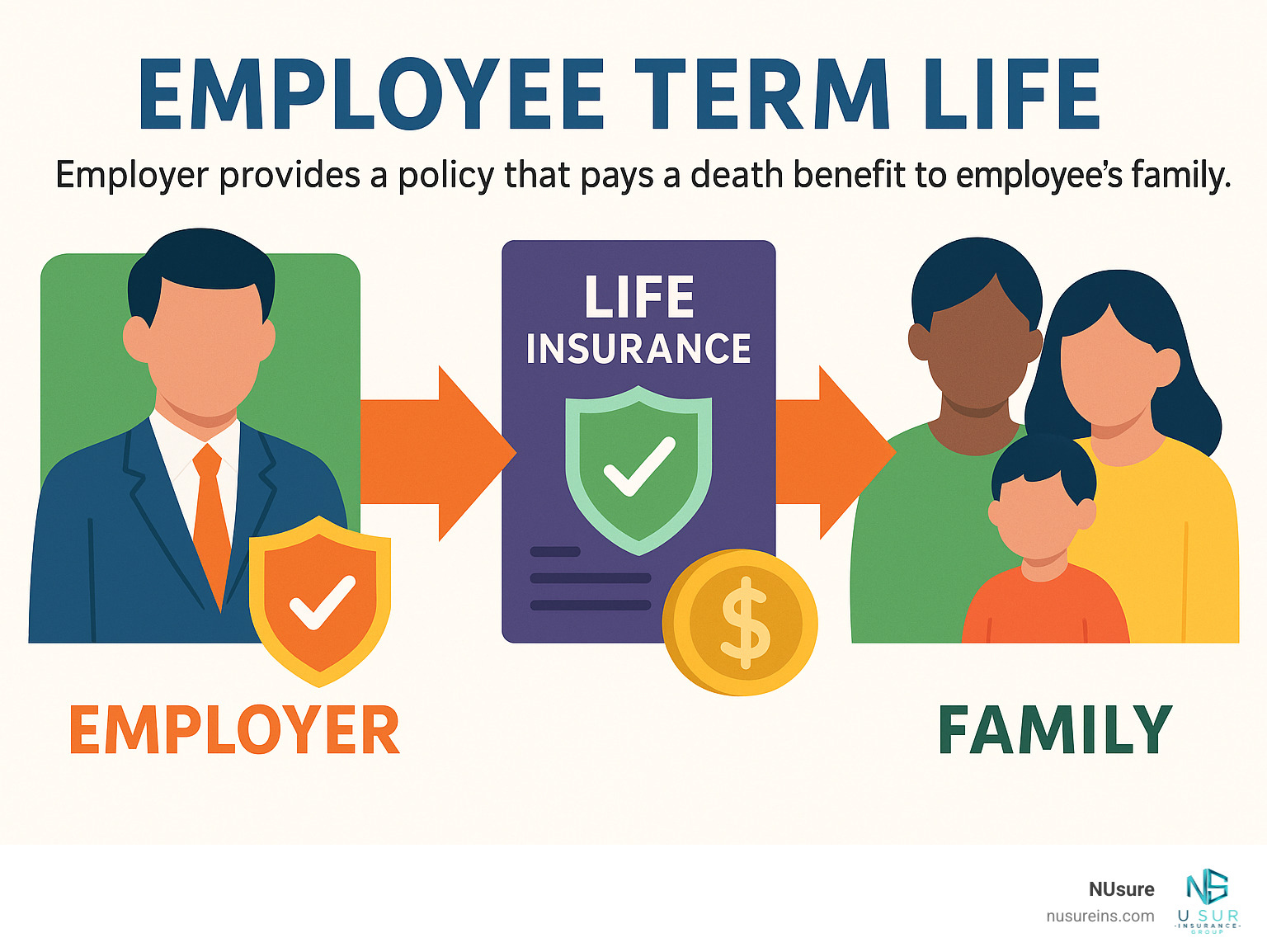
- How it works: Your employer typically pays the premiums. If you pass away during the coverage term, a lump-sum payment goes to your chosen beneficiaries.
- For employees: It offers a valuable financial safety net for your family, often at little to no direct cost.
- For employers: It helps attract and retain talent by offering a strong benefit.
In short, it’s a common, cost-effective way to protect your loved ones. Many companies offer this as a standard benefit, giving you peace of mind that your family would have financial support if the unexpected happened.
I’m Michael J. Alvarez, CPRM, CPIA. As an experienced risk and sales executive and serial insurance entrepreneur, I specialize in helping businesses and individuals understand and optimize their employee term life benefits and broader insurance programs.
Employee term life vocab to learn:
- converting group life insurance to individual coverage
- spouse term life insurance
- guaranteed insurability option
What is Employee Term Life Insurance and How Does It Work?

Employee term life insurance, also known as group life insurance, is your company’s way of providing a financial safety net. Your employer buys a master policy covering all eligible employees for a set term, usually one year at a time. By buying in bulk, they secure better rates than you could get individually.
The enrollment process is simple. Most plans offer guaranteed issue for basic coverage, meaning no medical exam is required. If you pass away while covered, your beneficiary receives a lump-sum payment. Coverage is typically tied to your salary (e.g., 1-2x your annual earnings) or a flat amount, and the policy renews annually while you remain employed.
Key Benefits for Employees and Employers
Employee term life insurance is a win for everyone. As an employee, you get a financial safety net for your family to cover funeral costs, mortgage payments, and daily expenses. The easy enrollment often means no medical exams for basic coverage, and the cost is free or very low. This provides peace of mind and affordable coverage at group rates.
For employers, this benefit helps with attracting talent and retaining employees. A solid benefits package makes a real difference in today’s job market. It’s a standard part of what people expect from a good employer, with 58% of private workers in the U.S. having access to life insurance through their jobs.
More info about Health Insurance.
Common Types of Employee Term Life Coverage
Your company might offer several types of employee term life coverage:
- Basic Term Life: The foundation provided by your employer, often at no cost. The amount might be a flat fee or one to two times your salary.
- Supplemental life insurance: Lets you buy extra coverage beyond the basic amount at favorable group rates. You pay for this additional protection.
- Voluntary life insurance: Similar to supplemental, you choose to buy it and pay the premiums through payroll deduction.
- Dependent coverage: Offers protection for your spouse and children, usually in smaller amounts.
- Accidental Death & Dismemberment (AD&D): An add-on that pays extra benefits if death or serious injury results from an accident.
Premiums and Tax Implications
Understanding the financial side of employee term life is important, especially for taxes.
For basic coverage, your employer-paid premiums usually don’t cost you anything. The IRS allows up to $50,000 of employer-provided coverage to be tax-free to you. If your company provides more than $50,000 in coverage, the premium for the extra amount becomes imputed income, meaning it’s taxed as if you received extra pay.
When you choose employee-paid premiums for supplemental coverage, you pay with after-tax dollars through payroll deduction, so it’s not considered taxable income.
The best news is the tax-free death benefit: your beneficiaries get the full payout without owing income taxes. Your age affects the cost of supplemental coverage, with rates typically increasing every five years, but group rates are still often better than individual ones.
Is Your Employer-Provided Coverage Enough?

While employee term life insurance is a fantastic benefit, is it enough? Employer plans often fall short. They typically offer a death benefit of one to two times your annual salary, while many experts suggest you need 8 to 10 times your salary to adequately protect your family. Statistics show a significant coverage gap: many workers are underinsured but few realize it.
Your employer’s policy might be sufficient if you’re young, single, and have no dependents. However, if you’re married, have a family, or have growing financial responsibilities, supplemental coverage becomes crucial.
Calculating Your True Life Insurance Needs
How much life insurance do you really need? There are several methods to estimate your needs:
- The 10x Salary Rule: A simple starting point is to aim for coverage that’s 8 to 10 times your annual salary. You might also add $100,000 to $150,000 per child for college expenses.
- Human Life Value Philosophy: This approach aims to replace your future earning potential. For those aged 18-40, a simple estimate is to multiply your salary by 30, with the multiplier decreasing as you age.
- The DIME Formula: This comprehensive formula considers four key areas:
- Debt: All outstanding debts like credit cards and car loans.
- Income Replacement: How many years of your income your family would need.
- Mortgage: The full payoff amount of your home loan.
- Education Costs: Future education expenses for your children.
Consider your family’s short- and long-term financial needs. Think about immediate expenses, raising children, college tuition, and a spouse’s retirement. Do you have a special needs child, a dependent parent, or significant co-signed debts? These are all crucial questions.
Use this tool to calculate your needs.
The Coverage Gap: Why Most Plans Fall Short
Most employer-provided employee term life plans fall short because they are designed as a basic benefit, not a comprehensive financial solution. Coverage amounts are typically tied to a modest multiple of your salary (1-2x), which is often inadequate.
Furthermore, these plans rarely account for personal inflation or major life events like marriage or buying a home. As your financial responsibilities grow, your base coverage may not keep pace. This creates a significant “coverage gap,” leaving your loved ones under-protected. Another key issue is that this coverage is tied to your employment, meaning it typically ends when your job does.
Employee Term Life vs. Individual Term Life Insurance
While employee term life is a great start, it’s important to understand how it compares to an individual term life policy. Both provide a financial safety net, but key differences affect how you should build your financial plan.
Here’s a quick look at how these two types of coverage compare:
| Feature | Employee Term Life Insurance | Individual Term Life Insurance |
|---|---|---|
| Ownership | Employer owns the master policy; you are a certificate holder. | You own the policy. |
| Portability | Generally not portable; tied to employment. May have conversion option. | Fully portable; stays with you regardless of employment. |
| Cost | Often employer-paid (basic) or lower group rates (supplemental). | You pay premiums; rates based on individual risk factors. |
| Coverage Limits | Capped by employer (e.g., 1-3x salary). | You choose coverage amount; generally much higher limits available. |
| Customization | Limited options; set by employer. | Highly customizable with riders and term lengths. |
| Underwriting | Simplified, often no medical exam for basic coverage. | Medical exam often required, more thorough underwriting. |
| Premium Stability | May change if employer changes plan or if you leave. Premiums for supplemental may increase with age. | Premiums are typically fixed for the entire term you choose (e.g., 10, 20, 30 years). |
| Renewability | Typically renews annually as long as you’re employed. | You choose the term length (e.g., 10, 20, 30 years); renewable at higher rates or convertible. |
Key Differences in Your Employee Term Life Policy
With a group employee term life policy, your employer owns the master policy, and you are covered as part of the group. This leads to a few key characteristics.
First, your employer chooses the insurance company and sets the terms, so your say is limited. Second, the coverage limits are often lower (often 1-3x your salary), which may not be enough to cover a mortgage or college tuition.
However, there are big upsides. You get group rates, which are often lower because risk is spread across many employees. Plus, the underwriting process is simplified. For basic coverage, you might not need a medical exam, making it easy to qualify, especially if you have health conditions.
Advantages of an Individual Life Insurance Policy
An individual term life policy can fill coverage gaps and provide a more personalized safety net.
The biggest advantage is portability. Your individual policy stays with you, regardless of your job. You’re never left unprotected because your employment status changes.
With an individual policy, you own it. You’re in charge of the coverage amount, beneficiaries, and other features. Customization is another huge plus. You can tailor the policy with the right coverage amount and term length (10, 20, or 30 years) and add riders for specific needs, like waiving premiums if you become disabled.
You can also get higher coverage amounts to truly protect your family based on their actual financial needs. Finally, level premiums mean your payments stay the same for the entire term, making budgeting easier. This highlights the growing desire for the personal control and long-term security an individual policy provides.
Learn more about Life Insurance.
Portability: What Happens When You Leave Your Job?

What happens to your employee term life insurance when you leave your job? The short answer: it’s often lost. Most policies are tied to your employment and terminate when you leave. This can create a dangerous gap in your financial protection, especially if your health has changed, making new coverage harder or more expensive to obtain.
Relying solely on an employer’s plan means your coverage could vanish when you retire or change jobs, leaving your family vulnerable. This lack of portability is a major concern for long-term financial planning.
Understanding Portability and Conversion Options
While many employee term life policies are not automatically portable, some offer options to help you avoid a lapse in coverage.
First, there’s portability. Some plans may let you “port” your coverage, meaning you can continue your group term life policy after leaving. You’d then pay the premiums directly to the insurance company, often at group rates. This is a great way to keep your coverage without new medical checks, but it isn’t always an option.
More commonly, you’ll find a conversion privilege. This allows you to convert your group coverage into an individual permanent life insurance policy (like whole life) when you leave, usually without a medical exam. While this is a valuable safety net, be aware that premiums for a converted individual policy are typically much higher, as they are based on your current age. You usually have a limited window, often just 30 or 31 days after leaving employment, to make this choice.
Some plans may offer innovative options that allow employees to keep their coverage at a group rate after leaving their job, making the transition smoother. However, these features are not universal. Always check your specific plan’s details regarding portability and conversion rights. Knowing these options upfront can save you significant worry and money.
Read more about industry trends.
Frequently Asked Questions about Employee Term Life
It’s normal to have questions about something as important as financial security. Here are answers to common inquiries about employee term life insurance.
Can I be denied employee term life insurance?
It’s rare to be denied basic employee term life coverage. Most group plans offer a “guaranteed issue” amount, meaning you can get a certain level of coverage without medical questions or an exam. This makes it accessible even if you have pre-existing health conditions.
However, if you opt for supplemental or voluntary amounts beyond the basic level, you might need to provide “evidence of insurability” (EOI). This usually involves a health questionnaire and, for larger amounts, a medical exam. In these cases, it is possible to be denied or offered a different rate based on your health history.
How do I name or change my beneficiary?
Naming a beneficiary is a critical step, and it’s usually a straightforward process handled through your company’s HR department or online benefits portal. You’ll use a beneficiary designation form to name your primary beneficiary (the first to receive the payout) and a contingent beneficiary (who receives it if the primary is no longer living).
It’s crucial to keep this information updated after major life events like marriage, divorce, or the birth of a child. Contact your benefits administrator to update your form and ensure your wishes are honored. This can make a huge difference for your loved ones during a difficult time.
Does employee term life insurance have a cash value?
No, employee term life insurance does not have a cash value. This is a key feature of all term life policies. Think of it as “pure protection,” similar to car or home insurance. You pay premiums for a set period (the “term”), and a payout is made only if death occurs during that term. If the policy expires, there’s no accumulated value.
This differs from permanent life insurance, like whole life, which provides lifelong coverage and includes a cash value component that grows over time. The focus of employee term life is solely on providing an affordable death benefit.
Conclusion: Building Your Financial Safety Net
Employee term life insurance is a valuable benefit and a fantastic starting point for securing your family’s future. It’s a convenient and affordable way to get crucial financial protection.
However, it’s often not enough on its own. Typical coverage amounts may not meet your family’s long-term needs, and the lack of portability can leave you vulnerable if you change jobs or retire.
The next step is to empower yourself with knowledge. Assess your personal needs using tools like the DIME formula or the 10x salary rule to understand how much coverage your family truly requires. This is about responsible preparation.
Once you have a clearer picture, you may find that supplementing your coverage with a personal, individual term life insurance policy is a wise move. It gives you more control, higher coverage limits custom to your family’s needs, and fixed premiums. Best of all, it’s fully portable—it stays with you, no matter where your career takes you.
Life insurance is a crucial cornerstone of any solid financial planning. It’s a promise to your family, ensuring their stability if the unexpected happens.
Navigating insurance can feel overwhelming, but NUsure makes it simple. We help you compare quotes from over 50 top-rated carriers to find the right personalized policies to fill any coverage gaps, all without extra fees. We’re your guide to saving time and money while gaining peace of mind.
Don’t leave your family’s financial security to chance. Take that smart step today. Understand your employee term life options, and let’s work together to build a robust financial safety net for your loved ones.